Best Cat Towers for Small Apartments in 2026: Vertical, Not Sprawling
As an Amazon Associate I earn from qualifying purchases. Product details may change; verify on Amazon before purchase.
The short answer
If you only want one recommendation: Amazon Basics Cat Tower with Hammock. Small floor footprint, vertical layout, and stable enough for a studio — the best 'gets used, doesn't eat your walking space' option in this category.
Check price on Amazon →🔍 How this guide was put together (Editorial Standards)
This guide compares options using published manufacturer specifications, patterns in publicly visible owner reviews, and reputable expert sources. We do not operate a physical testing lab; see our how-we-research page for details.
| Rank | Product | Name | Why we picked it | Buy |
|---|---|---|---|---|
| Top pick |  | Amazon Basics Cat Tower with Hammock and Scratching Post (compact) | Check price | |
| Runner-up |  | Hey-brother Cat Tree Tower with Tiered Padded Platforms & Condos | Check price | |
| Also great | 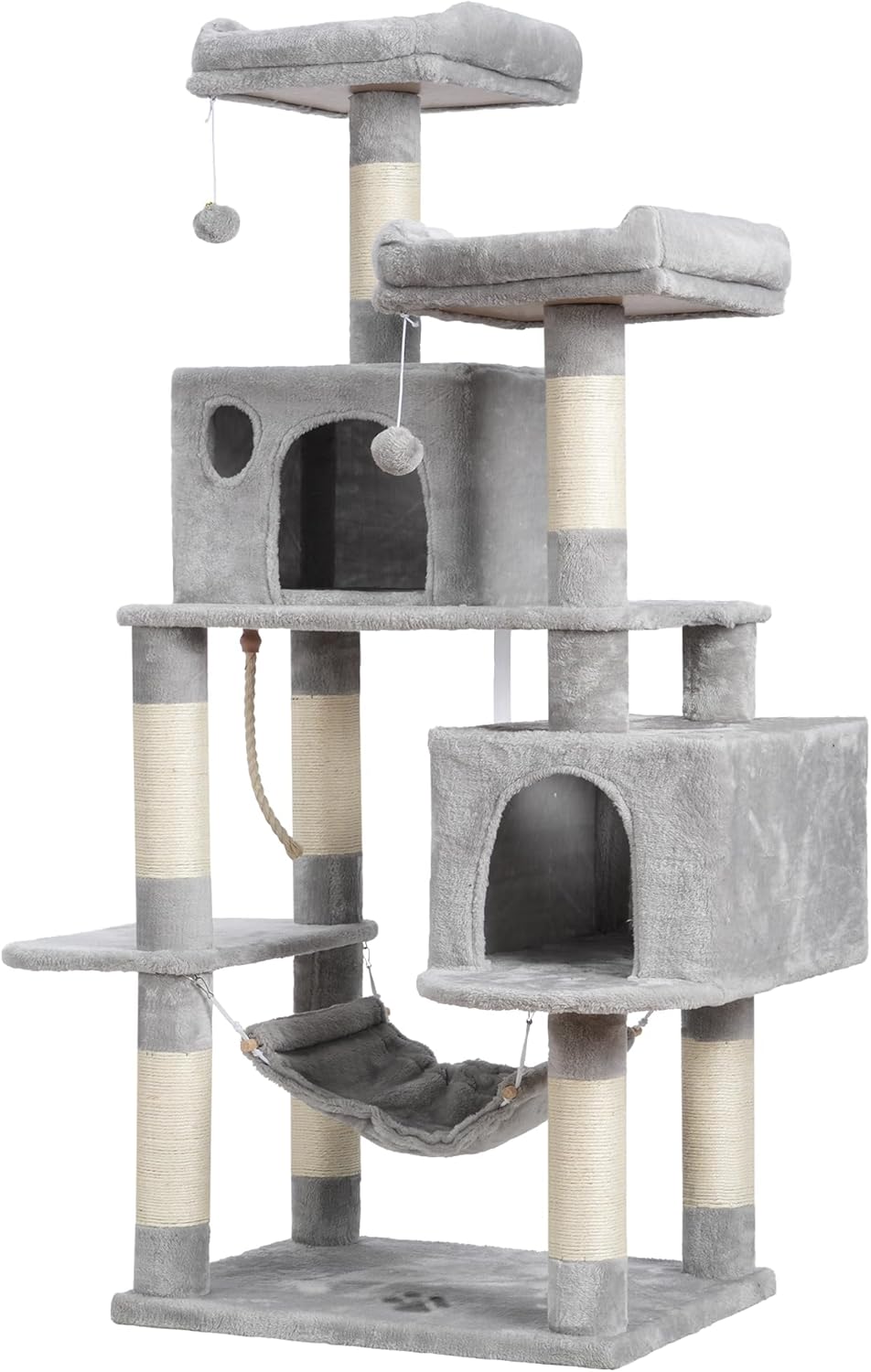 | Hey-brother Cat Tree Tower with Sisal Scratching Posts, Big Condo | Check price |
📑 Table of contents
Small-apartment cat furniture has the opposite problem of a big-cat tree: here the constraint isn’t your cat’s weight, it’s your floor space. Every square centimetre a tower occupies is a square centimetre you can’t walk through. The good news is that cats don’t actually want floor sprawl — they want height. A well-chosen vertical tower gives a cat territory, a lookout, and an escape route while barely touching your walking space. This guide shows how to choose one that fits a studio or one-bedroom without turning it into an obstacle course.
Why vertical beats sprawling for cats
Cats are territorial in three dimensions, not two. A tall, narrow tower gives more usable territory than a wide, low one because it adds vertical layers — perches at different heights that a cat treats as separate zones. Height also provides security: being up high lets a cat watch the room and feel safe, which matters more in a small, busy space where there’s nowhere to retreat. So the design goal is simple: maximise height and perch count, minimise floor footprint.
How we evaluate small-space towers
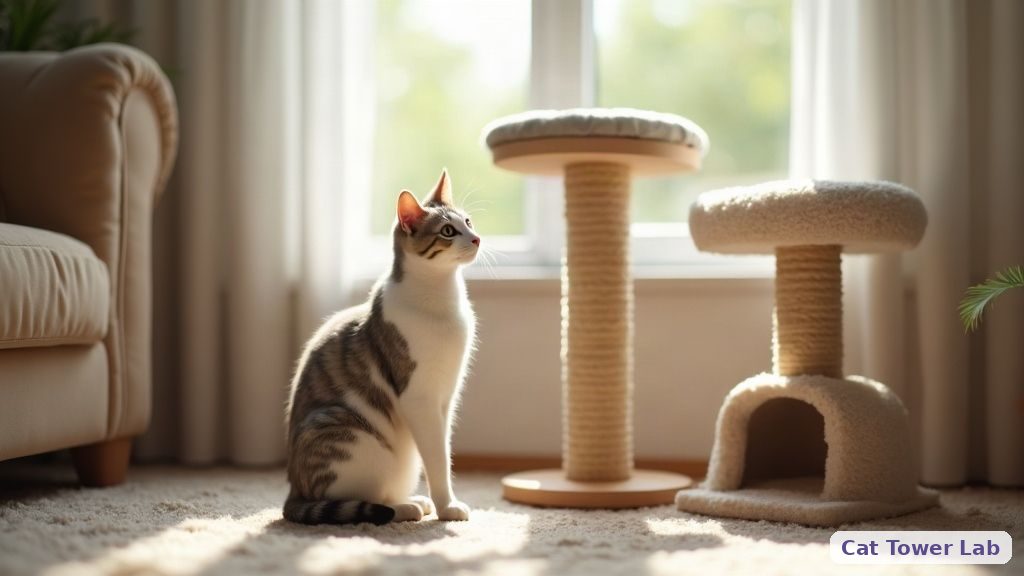
Research-based comparison weighted on three measurable factors: floor footprint (width × depth actually occupied), usable height and perch count, and rental-friendliness (does it need drilling?). We synthesise manufacturer specs with recurring themes in verified owner reviews from people in apartments and studios.
The buying criteria for small spaces
1. Floor footprint
Aim for a base under roughly 40 × 40 cm so the tower stays out of the walkway. A tall tower on a small base needs its wall strap for stability — never skip it in a tight space where the tower is easy to knock.
2. Height and perch layout
Because you’re trading floor space for vertical space, get the height. Look for multiple perches at staggered heights and a top perch positioned for a view. Height matters more than the number of gadgets bolted on.
3. Shape: narrow, corner, or wall-adjacent
- Narrow vertical towers stand tall on a small base — the best footprint-to-height ratio, ideal against a wall.
- Corner-fit towers turn a dead corner into cat territory with a triangular base that’s more stable than it looks.
- Wall-adjacent / slim trees hug the wall and lean on a stable base rather than drilling — the rental-friendly choice.
4. Rental rules
If you rent, freestanding + wall strap beats drilled shelves (which you’d have to patch). If you own and want zero floor use, wall-mounted shelves are worth considering — see our wall-mounted cat shelves guide.
Layout ideas for studios and one-bedrooms
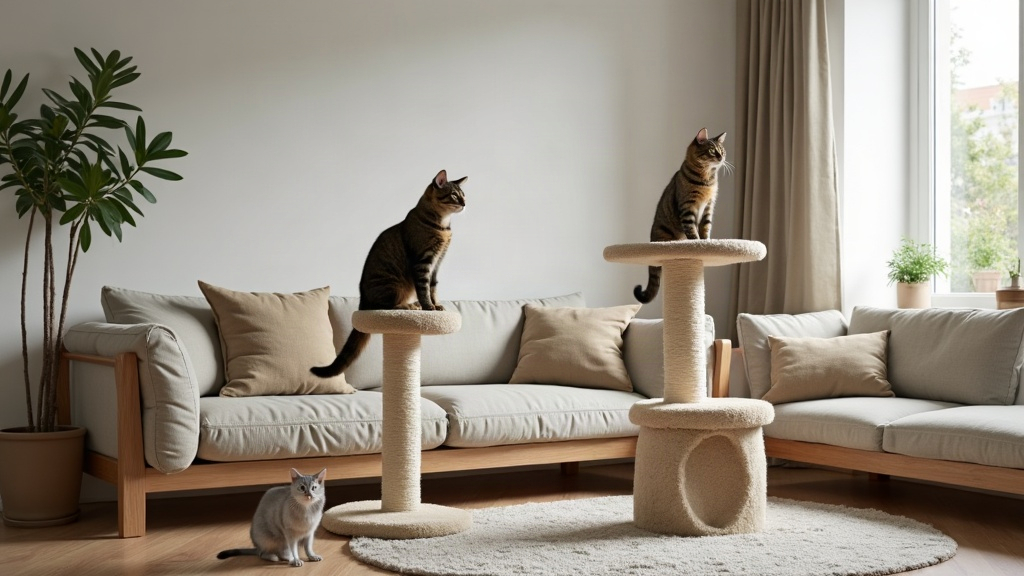
- The window corner. Place a corner tower where two walls meet near a window — it uses space you weren’t using and gives the best view in the flat.
- The vertical stack. A narrow tower against a wall next to a bookshelf lets the cat move between tower and shelf, extending territory without extra floor use.
- Behind the sofa. A slim tower behind or beside a sofa uses otherwise-dead space and gives the cat a raised route.
Small-space mistakes to avoid
- Buying a wide “deluxe” tree because it has more features — it eats your floor.
- Skipping the wall strap on a tall, narrow tower in a space where it’s easily bumped.
- Putting the tower in a back room to save living-room space — the cat won’t use it, defeating the purchase. Cats want to be where you are.
- Ignoring vertical routes — pairing a tower with a shelf or cabinet multiplies its value.
About our product picks
Our narrow, corner, and rental picks are chosen against the criteria above. Prices, ratings, and images come live from Amazon — never hard-coded or invented. Use the footprint and height rules here to evaluate any tower you’re considering.
Frequently asked questions
What is the smallest cat tree you can get? The smallest practical cat tree is around 40 cm base × 60 cm tall with one perch — but cats in small spaces still need vertical territory. The sweet spot is a narrow tower 28-35 cm base diameter at 120-150 cm tall with 3 levels: small footprint, meaningful climbing. See our full guide to small apartment cat furniture for dimensions.
Do cats in small apartments get bored? Yes, more so than cats with outdoor access. Vertical territory (cat trees, wall shelves) directly reduces stress-related behaviours in indoor cats according to research from the Cornell Feline Health Center. Even one narrow cat tree significantly enriches a studio apartment environment.
Tower or wall shelves for a tiny flat? Towers if you rent (no wall damage); shelves if you own and want zero floor use. Many small-space owners combine a slim tower with a couple of shelves.
Will a tall, narrow tower tip over? Not if you use the included wall strap — it’s the single most-skipped safety step and the most important one in a small, easily-bumped space.
How do I fit a cat tower in a studio? Use a corner or a wall-adjacent slim design, place it by a window, and go vertical. A ~40 cm base with good height gives a cat plenty of territory for very little floor.
Next: best cat trees for large cats · where to place a cat tree · wall-mounted cat shelves
Related: Floor-to-ceiling cat trees