Where to Place a Cat Tree: Room-by-Room Placement Guide (2026)
As an Amazon Associate I earn from qualifying purchases. Product details may change; verify on Amazon before purchase.
🔍 How this guide was put together (Editorial Standards)
This guide compares options using published manufacturer specifications, patterns in publicly visible owner reviews, and reputable expert sources. We do not operate a physical testing lab; see our how-we-research page for details.
📑 Table of contents
- What cats actually want from a spot (and why it decides everything)
- Room-by-room: best spots
- Spots to avoid
- Setup + safety rules for wherever you place it
- The placement + attraction sequence
- Multi-cat homes: territory + placement
- Moving an existing tree that’s not being used
- For rental apartments
- Frequently asked questions
Placement is the most under-rated buying decision. The same cat tree can be a favourite lookout or completely ignored depending entirely on where you put it. This guide covers exactly what cats want from a location, room-by-room ideas that consistently work, spots to avoid, and how to fix placement for a tree already being ignored.
What cats actually want from a spot (and why it decides everything)
Cats aren’t picky about brands — they’re picky about vantage. Three things drive where a cat wants to spend time, and a tree that lands in a location matching all three gets adopted within days. Miss one and it sits unused.
Height with a view. Cats evolved as ambush predators; height gives them a sense of safety AND stimulation from watching movement below. Trees near a window overlooking a garden, street, or bird feeder outperform trees against a blank wall almost every time.
Sightline to the room’s entrance. Cats want to see who comes in. A tree in a corner that overlooks the doorway gets used more than one against the same wall as the door.
Proximity to their humans. Cats are more social than most people realise. A tree in the living room where the family spends evenings gets used 5-10× more than the same tree in a spare bedroom. This is the #1 fixable placement mistake.
Room-by-room: best spots
Living room
Almost always the best room. Best spots inside it:
- By the window overlooking outside activity — gold standard.
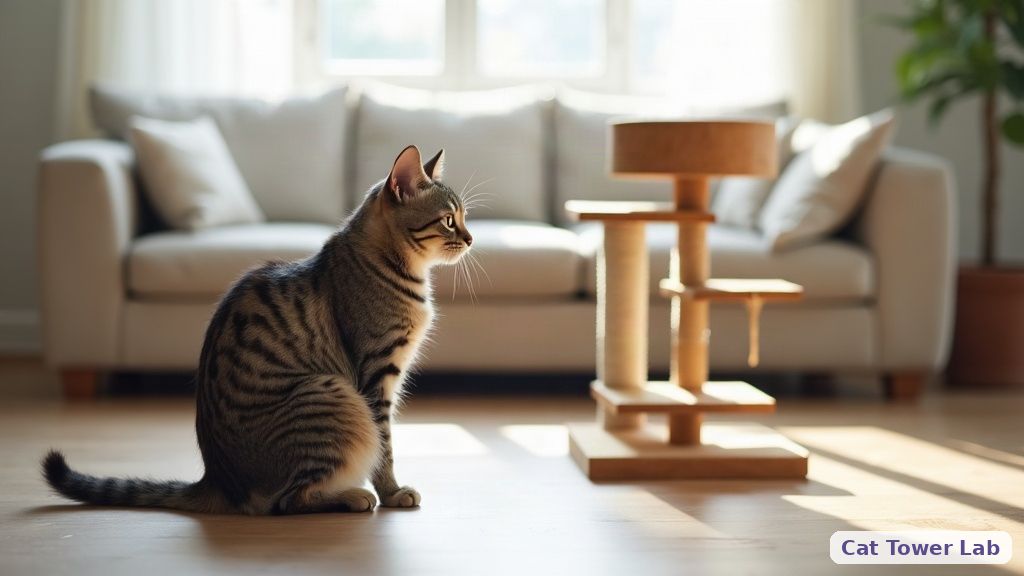
- Corner facing the sofa — cat can watch you AND the room’s entrance.
- Next to a bookshelf — extends vertical territory (cat can hop between).
Studio or one-bedroom
Vertical, not sprawling — see our small-apartment guide. Best spots:
- Window corner — the intersection of two walls near a window doubles the wall-mount options and uses dead space.
- Behind or beside the sofa — slim towers hide behind furniture but stay reachable.
- Wall-adjacent by the TV — cats already gravitate to warm electronics.
Bedroom
Only if your cat sleeps with you. A tree by the bedroom window can work for cats who like watching their humans sleep. Avoid if the bedroom is closed during the day — cat can’t access it.
Home office
Good for cats who bonded with the WFH parent. Place by the desk (they’ll want to watch your screen) or by the office window.
Kitchen
Generally avoid. Loud appliances startle cats, and food smells confuse them (they’ll try to jump on counters). Only good if you have a quiet breakfast corner.
Spots to avoid
Isolated spare rooms. Out of sight = out of use. This is the single most common mistake — buying a “big” tree and putting it where you have space rather than where the cat wants to be.
Next to noisy appliances. Washing machines, dishwashers, loud fans. Cats avoid startle-zones.
Blocking a walkway. You’ll subconsciously bump the tree and cats notice instability from repeated knocks. Also, you’ll move it eventually.
Directly under a low shelf or ceiling beam. Cat launches up, hits head, learns to distrust the tree.
In a hot conservatory or against a radiator. Cats like warm spots but not overheated — a tree that gets too hot in summer becomes unused.
Setup + safety rules for wherever you place it
- Anti-tip strap for anything tall — near a wall means you can use it. Skip this and a launching cat can tip a tall tree.
- Give 30 cm ceiling clearance above the top perch so cats aren’t squished.
- A rug or plywood board under the base on carpet — soft carpet lets a rigid base rock, which cats hate. Full breakdown in our stability guide.
- Don’t block heater vents — bad airflow, hot base.
The placement + attraction sequence
- Place the tree in the best spot per rules above.
- Rub the posts with silvervine or catnip to make it interesting.
- Add a familiar blanket to the top perch so it smells like your cat.
- Wait 1-2 weeks — new objects take time. Don’t relocate daily.
- If still ignored → work through our why-cats-ignore-trees troubleshooter.
Multi-cat homes: territory + placement
One cat can “claim” a tree and drive others off. Signs: one cat uses it, others hover but don’t approach. Fix:
- Two smaller trees in different rooms rather than one big central tree reduces competition.
- Wall-mounted shelves (see our shelves guide) create alternative vertical territory.
- A tree with multiple isolated perches at different heights lets cats claim their own level.
Moving an existing tree that’s not being used
If you’ve had a tree for weeks and it’s ignored, try this sequence before buying a new one:
- Move it to a new spot per Room-by-room — costs nothing.
- Refresh scent — catnip/silvervine + your cat’s blanket.
- Reward exploration with treats when they investigate.
- Give 5-7 days in the new spot before judging.
70% of “ignored” trees start getting used just from moving to the right spot.
For rental apartments
Freestanding + wall strap beats anything drilled — no wall damage to patch. Anti-tip strap uses a small stick-on or screw-hidden anchor; check your lease if you’re unsure. If drilling is out entirely, choose a shorter, wider-base tree that’s stable without a wall anchor.
Frequently asked questions
Can I put a cat tree outside? Not permanently — weather ruins the sisal and cover materials fast. On a covered balcony under shade, it can survive if brought in when raining.
How many cat trees does one cat need? One is usually enough IF placed right. Multi-cat homes benefit from 2+ in different rooms.
My cat prefers to lie on top of the fridge — should I just leave it? No — that means your cat wants high vantage in a room they spend time in. Put the tree by the fridge or where they naturally lounge; they’ll switch.
Where’s the worst place to put a cat tree? In a room your cat rarely enters. Bought a tree for the guest bedroom “so it doesn’t take living-room space”? Almost guaranteed to be ignored.
Do cats prefer trees near cold spots or warm spots? Warm — cats seek warmth. Near a sunny window is ideal; near a radiator is too much.
Related: best cat trees for large cats · cat towers for small apartments · how to get your cat to use their tree