Cat Trees for Kittens and Senior Cats: What Changes at Each Life Stage
As an Amazon Associate I earn from qualifying purchases. Product details may change; verify on Amazon before purchase.
🔍 How this guide was put together (Editorial Standards)
This guide compares options using published manufacturer specifications, patterns in publicly visible owner reviews, and reputable expert sources. We do not operate a physical testing lab; see our how-we-research page for details.
📑 Table of contents
- Kittens (under 6 months) — safety first
- Active adults (1-8 years) — height is a feature
- Senior cats (10+ years) — accessibility first
- Transition points to plan for
- Multi-cat homes across life stages
- Signs the current tree no longer fits your cat’s age
- Kitten vs senior cat tree — quick comparison
- Frequently asked questions
Age changes what makes a cat tree safe and appealing more than most people realise. A tree that’s perfect for an athletic three-year-old can be genuinely risky for a young kitten or an arthritic senior — different bodies, different capabilities, different risks. This guide walks through what changes at each end of the life spectrum and which trees suit each.
Kittens (under 6 months) — safety first
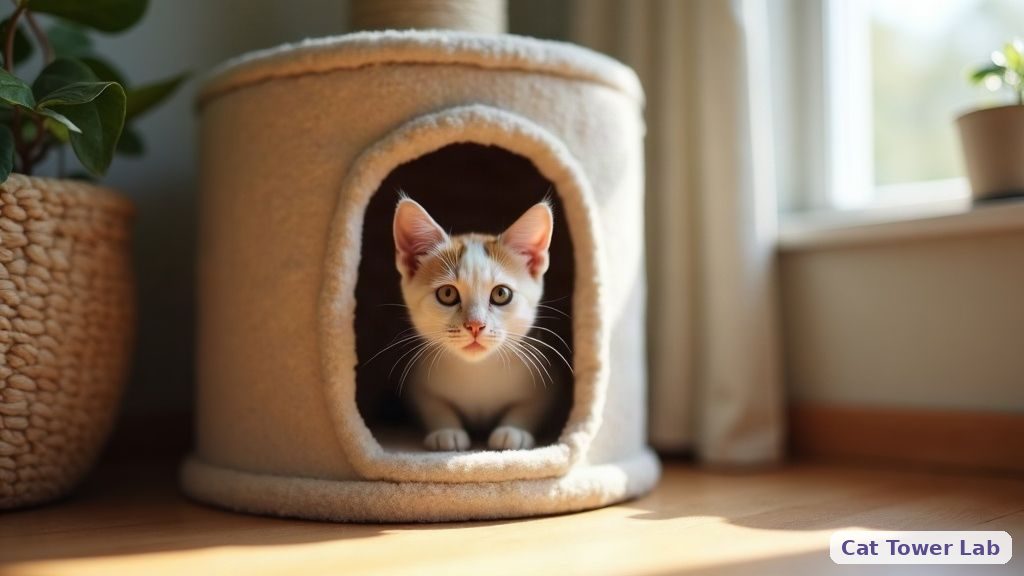
Kittens are enthusiastic climbers but uncoordinated jumpers. They test their limits without knowing them, which means falls from heights they shouldn’t reach are the main risk.
What kittens need
- Lower total height — a lower height is often recommended. Anything a kitten can climb, they will; keeping the maximum height limited limits the fall.
- Closely spaced levels — perches roughly closely spaced, so a missed jump is a short drop.
- High-sided condos and hammocks — kittens sleep hard and roll; sides prevent falls while sleeping.
- Sturdy base — kittens play with abandon and can topple lighter trees.
- Soft landing zones — a rug or blanket under the base helps if they slip.
What to avoid for kittens
- Tall towers (very tall towers) until they’re older and surer.
- Wide gaps between platforms — jump too far, miss, hurt.
- Fragile toys or dangling parts with small strings that could be swallowed.
- Trees with any sharp edges — kittens rub, chew, and bite everything.
As kittens grow
Between over time they gain coordination and confidence. Around 8-10 months most kittens are ready for a taller adult tree — but their play style stays rough, so continue prioritising sturdy construction over fancy features. Full sizing guidance in our size guide.
Active adults (1-8 years) — height is a feature
The “peak years” for cat-tree use. Adult cats value:
- Height — for security and observation. A tall tree with a top perch overlooking the room is often the favourite spot.
- Multiple varied levels — different heights to claim for different moods.
- Serious sisal for scratching — this is the age they use trees hardest.
- A view — position matters as much as tree design; see our placement guide.
For big adult breeds (Maine Coon, Ragdoll, Savannah), size up EVERYTHING — base, posts, perch size, weight rating. See our large-cat guide.
💡
Adult tree tipThe most-used feature in owner reviews of adult trees is a **top perch with a window view**. Height without a view often goes unused; even modest height with a view usually wins.
Senior cats (10+ years) — accessibility first
Older cats often develop arthritis, reduced jumping ability, or vision decline. A tree that suited them at several years may become inaccessible by 12. Signs it’s time to reconsider:
- Stops using higher levels
- Hesitates before jumping
- Misses jumps that used to be easy
- Sleeps only at floor level
What senior cats need
- Ramps or steps rather than big vertical gaps. Some trees have built-in steps; you can also add a small pet ramp beside a tree.
- Lower overall height so main perches are reachable without leaping.
- Wider, well-padded perches — arthritis makes lying on hard surfaces uncomfortable.
- Heated or extra-warm spots — older cats appreciate warmth more (blanket on top, near a sunny window).
- Solid stability — a wobble that a young cat ignored can spook a senior into avoiding the tree entirely.
What to avoid for seniors
- Tall towers with big gaps — inaccessible.
- Slippery perches — reduces confidence.
- Trees that require jumping to enter — a condo with a high entry hole becomes unusable.
Transition points to plan for
Realistic timeline for most cats:
- 0-6 months (kitten): low, safe, closely spaced. Cheap to buy since they’ll outgrow it.
- over time (adolescent): transition to a taller adult tree; supervise early climbs.
- 1-8 years (active adult): peak use — invest in a quality tall tree here.
- 8-12 years (mature): they may still use the adult tree fine; watch for signs of hesitation.
- 12+ years (senior): consider a lower-profile replacement or add ramps.
Most owners buy 2-3 trees across a cat’s life. That’s normal and correct.
Multi-cat homes across life stages
If you have both a kitten and a senior:
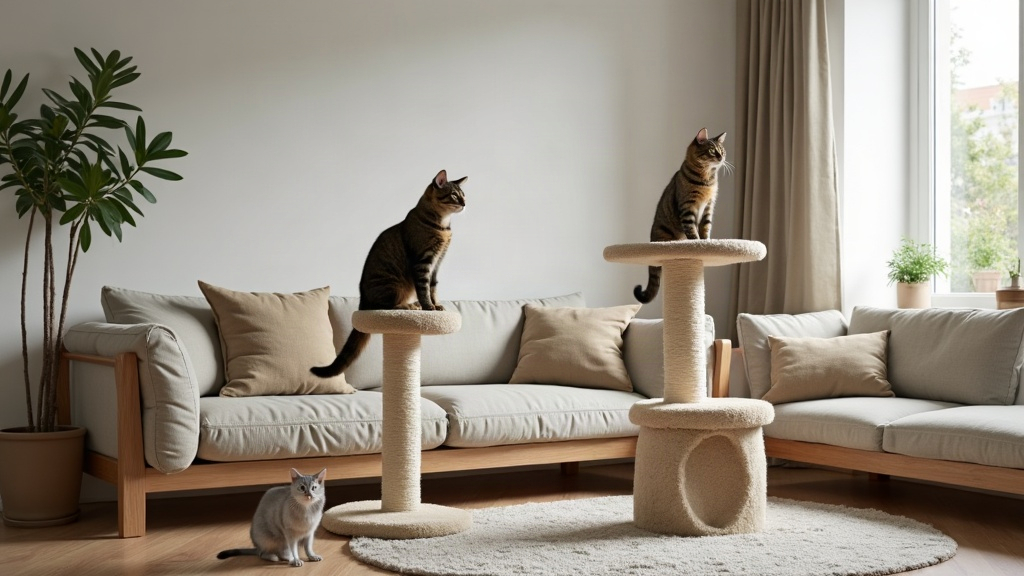
- Two trees — one lower-profile for the senior, one adult-standard for the older cat (which the kitten can grow into).
- Wall shelves at low levels for the senior + high runs for the active cat — see wall shelves guide.
- Separate feeding stations at appropriate heights so the senior doesn’t have to jump for food.
Signs the current tree no longer fits your cat’s age
- Cat stopped using it entirely for over a month
- Uses only the lowest level (was using higher levels before)
- Hesitates or misjumps
- Sleeps on the floor beside the tree instead of on it
Any of these = time to adapt (add ramp, add step) or replace.
Kitten vs senior cat tree — quick comparison
| Feature | Kitten tree | Senior cat tree |
|---|---|---|
| Height | Lower height | Even lower height |
| Ramps/steps | Optional (low height) | Mandatory |
| Platform lip | Yes (can’t self-rescue) | Yes (arthritic grip) |
| Sisal | Yes (scratching essential) | Yes (low-effort scratch) |
| Enclosures | Optional | Preferred (warmth) |
| Stability | Critical (launch forces) | Critical (lean weight) |
| Non-slip surface | Important | Critical |
Frequently asked questions
Are cat trees good for kittens? Yes — cat trees satisfy three developmental needs simultaneously: climbing (confidence), scratching (claw health), and territory (security). According to the Cornell Feline Health Center, environmental enrichment including vertical territory reduces stress-related behaviours in indoor cats. Keep the tree low and supervised until 12-16 weeks.
At what age can kittens use a cat tree? From around 8 weeks (once fully weaned and mobile), but only low trees — a low height. Full-height trees are appropriate from 4-5 months when coordination is reliable.
What is the 3-3-3 rule for kittens? It describes the adjustment period for newly adopted kittens: 3 days to decompress, 3 weeks to learn your routine, 3 months to feel fully at home. During the first 3 days, keep the cat tree accessible as a safe retreat — it gives the kitten a “home base” to observe from.
What is the best cat tree for kittens? Look for: lower height, platforms no more than close together, sisal posts for scratching, and a stable base. Specific picks are in our large cats guide (which includes models also sized for kittens).
How young is too young for a cat tree? Kittens can use small trees from about 8 weeks — supervise, keep it low, avoid tall structures until they’re coordinated.
Do senior cats need a completely new tree, or can I modify? Often modify first — add a pet ramp, add a step, move to a lower placement. Full replacement only if the tree design is fundamentally wrong.
Can one tree work a cat’s whole life? Rarely. A tree designed for kittens is boring by age 2; an adult tree becomes inaccessible by age 14. Plan for at least 2 replacements.
My cat is 12 — do I need a “senior” tree yet? Watch for hesitation before jumping and how much they use higher levels. If they’re still moving freely at 12, no rush. Reassess every over time.
What about disabled or 3-legged cats? Same principles as seniors — prioritise ramps, low profile, wide perches. Some owners build custom tree-plus-ramp setups.
Related: how to choose the right size · best cat trees for large cats · safety checklist