Cat Tree Safety Checklist: 12 Things to Check (2026)
As an Amazon Associate I earn from qualifying purchases. Product details may change; verify on Amazon before purchase.
🔍 How this guide was put together (Editorial Standards)
This guide compares options using published manufacturer specifications, patterns in publicly visible owner reviews, and reputable expert sources. We do not operate a physical testing lab; see our how-we-research page for details.
📑 Table of contents
Most cat-tree accidents come down to a short list of avoidable issues. Tip-overs from unstable bases, injuries from exposed hardware, choking hazards from unravelling sisal — every one of these is predictable and preventable with a five-minute check at assembly and quick re-checks every few months. This is the complete safety checklist, ordered by how often each item causes real problems.
The 12-point safety check
1. Base stability
The single biggest safety factor. Push the top of the tree with moderate force — if the base rocks visibly, that’s the amount of movement your cat will experience jumping off the top. Cats avoid unstable trees AND unstable trees fail more over time as joints loosen from constant motion.
- Fix: for a tall tree with a small base, use the anti-tip wall strap (below) and add a plywood board under the base on carpet.
- Replace if: base is small relative to height AND no wall strap included AND the tree can’t be strapped in your setup.
See our stability deep-dive for the physics.
2. Anti-tip strap installed
Any tree over ~150 cm needs a wall anchor. Tip-overs are the most serious cat-tree accident — a heavy tree falling on a cat causes real injuries. The strap is usually a small fabric tether that screws or sticks to the wall.
- Cost of the strap: nearly zero.
- Skipped by owners: about 60% based on owner reviews.
- If your tree didn’t include one: aftermarket furniture anchors from any hardware store work.
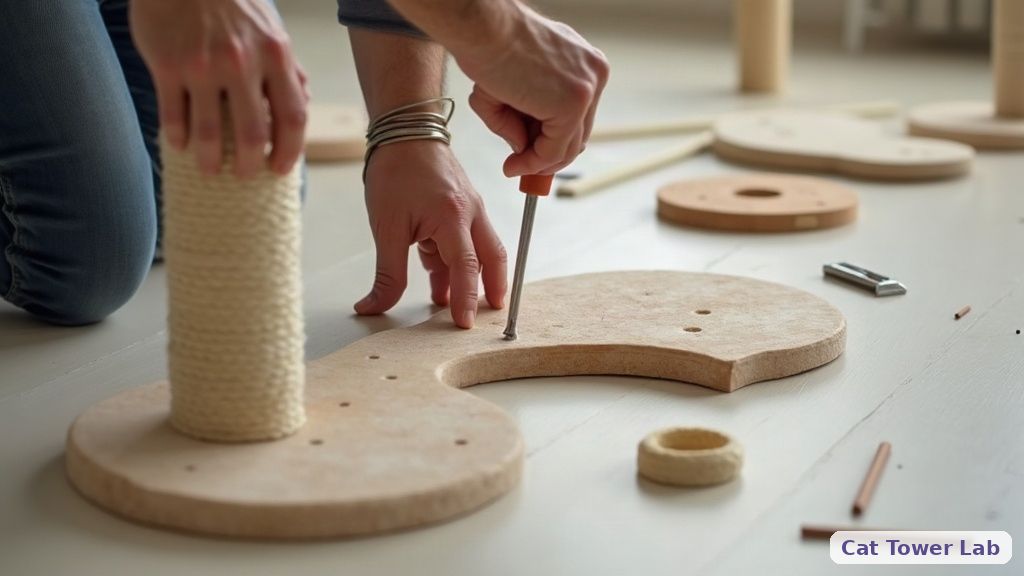
3. Tight hardware — bolts and screws
Trees loosen with use. Every few months, re-tighten every bolt from underneath the base. Loose fasteners cause wobble that snowballs — small wobble → cat jumps harder to compensate → more force on joints → more loosening.
- Frequency: check every relatively quickly.
- Best trees for this: models with bolt-together construction (you can re-tighten) rather than staple-only (permanent, cannot service).
4. Per-perch weight rating vs your cat’s weight
Never assume a “large cat” tree can hold your specific cat. Check the per-perch rating and add 30% margin — cats don’t sit, they launch and land with more force than their static weight suggests.
5. Perch size vs your cat’s body
Perches should fully support your cat with room to turn around. A perch a cat overflows is a fall risk — they can slip when repositioning. See our sizing guide.
6. No exposed staples, sharp edges, or splinters
Run your hand — palm and fingers — over every surface a cat will touch. Common issues:
- Exposed staples underneath perches where fabric is attached
- Sharp trim on plastic parts
- Splinters on unfinished wood edges
Fix: file, tape, or trim any hazards. Report defective units to the seller.
7. Sisal ends secured
Frayed, unravelling sisal can catch claws and pull, painful for the cat and distressing enough that they’ll avoid the tree. Ends should be tucked, glued, or stapled to prevent unravelling. Re-glue with pet-safe adhesive if they start to loosen.
8. No loose plush or fabric threads
Cats can ingest long threads. Check the top perch fabric and any hanging elements. Trim loose threads before they get pulled.
9. Safe placement — no drop zones
The tree’s placement matters as much as the tree itself:
- Not directly under low shelves the cat could hit their head on jumping up.
- Not next to breakable objects a cat launching off could knock over.
- Not against a hot radiator or in direct summer sun.
- Base not blocking a walkway (you’ll knock into it, and cats hate that).
Full breakdown in our placement guide.
10. No cords or hazards near the base
Curious cats chew. Any cords (lamps, chargers, cables) near the base need to be secured or moved. Toys with strings or dangling elements attached to the tree should be checked weekly for wear.
⚠️
String hazardCats can ingest long string, which is a life-threatening intestinal issue. Cut off any long dangling strings from tree toys and replace with sturdy alternatives.
11. Life-stage appropriateness
A tree that was safe for your adult cat may not be safe for a kitten or a senior. Kittens fall from heights they shouldn’t reach; seniors slip from perches spaced too far apart. See our life-stage guide.
12. Regular inspection routine
Add these to a household routine:
- Weekly: quick visual — anything looks damaged, loose, or worn?
- Monthly: re-tighten bolts; check sisal ends; vacuum + wipe.
- Annually: full inspection — core intact, base still solid, fabric not worn through.
The full routine (with times, tools, and what to check when) is in our cleaning and maintenance guide — the two guides work together: this checklist for safety, that guide for routine care that extends the tree’s life.
Signs it’s time to replace, not repair
Some issues mean the tree is done:
- Core is broken or water-damaged (structural failure)
- Base has cracked or is warping
- Wobble persists after re-tightening + shimming + wall strap — the design itself is inadequate
- Sisal is bare on every post and re-wrapping isn’t worth it
- Cat has stopped using it entirely for over a month after moving/refreshing
Multi-cat safety notes
- Weight rating matters more — two 6 kg cats on one perch = 12 kg + jump forces. Rate for the total, not just one.
- Multiple exits from condos so a cat can’t be cornered by another.
- Height for the timid cat — a bullied cat needs high escape territory to feel safe.
First-time buyer’s 5-minute safety pass
Right after assembly, do this:
- Push the top of the tree hard both directions. Rocks? Add wall strap.
- Run your hands over every surface. Sharp bits? File or cover.
- Check sisal ends everywhere. Loose? Re-glue.
- Confirm the base doesn’t rock on your floor. Rocking on carpet? Add plywood.
- Look for the anti-tip strap in the box. Install it.
Do those five and you’ve handled the vast majority of real safety risks.
Frequently asked questions
How often should I re-tighten the bolts? Every relatively quickly for a tree in daily use. More often if you have multiple heavy cats.
Is the anti-tip strap really necessary? For tall trees with active or big cats, yes. It’s the cheapest safety upgrade and prevents the worst possible accident.
Are cat trees safe to leave when we’re away? Yes if properly installed and inspected. The tree isn’t the risk when you’re away — cords, small parts, and open windows are.
My cat scratches so hard the tree rocks. Should I worry? Yes — that’s telling you the base is too small for your cat’s force. Add a wall strap and plywood board, or consider a heavier tree.
Can a tree cause paw injuries? Rarely, unless there are exposed staples or sharp edges. The 5-minute inspection catches these.
Related: sturdiest anti-wobble trees · how to choose the right size · trees for kittens and seniors