Cat Tree Too Tall for Low Ceilings: What Are My Options?
As an Amazon Associate I earn from qualifying purchases. Product details may change; verify on Amazon before purchase.
🔍 How this guide was put together (Editorial Standards)
This guide compares options using published manufacturer specifications, patterns in publicly visible owner reviews, and reputable expert sources. We do not operate a physical testing lab; see our how-we-research page for details.
📑 Table of contents
Your cat tree arrived, you assembled it, and the top perch is pressing into the ceiling — or worse, the tree won’t even stand up. This is common. Many “large” cat trees are 70–80 inches tall (178–203 cm), designed for standard 8-foot (96-inch / 244 cm) ceilings. If you have a 7-foot ceiling, a basement suite, or a room with dropped panels, those dimensions don’t work. Here’s what to do.
The quick math: ceiling clearance
To fit safely, a cat tree needs adequate clearance between the top perch and the ceiling — more is better for cat comfort.
| Your ceiling height | Maximum tree height |
|---|---|
| 8 ft (96 in / 244 cm) | ~72–76 in (183–193 cm) |
| 7.5 ft (90 in / 229 cm) | ~66–70 in (168–178 cm) |
| 7 ft (84 in / 213 cm) | ~60–64 in (152–163 cm) |
| 6.5 ft (78 in / 198 cm) | ~54–58 in (137–147 cm) |
If your current tree is taller than your ceiling allows, you have five options.
Option 1: Choose a shorter tree
The simplest fix. Many cat trees come in 48–60 inch versions that fit under low ceilings while still giving cats height to climb. You trade some vertical territory, but a tree your cat can use is better than one crammed against the ceiling.
When to pick this: You haven’t bought yet, or you’re willing to return/exchange the current tree.
For compact options, see our cat towers for small apartments guide — those trees prioritise vertical space efficiency on small footprints, and many models stay under 60 inches.
Option 2: Go wall-mounted
Wall-mounted cat shelves eliminate the floor-to-ceiling constraint entirely. You mount individual shelves at whatever heights fit your ceiling, and your cat climbs from shelf to shelf. This is a highly flexible solution for very low ceilings (under 7 feet) or angled attic rooms.
Pros:
- No floor footprint
- Fits any ceiling height
- Modular — add more shelves later
Cons:
- Requires drilling into studs (not rental-friendly unless you can patch)
- Less “contained” scratching area than a traditional tree
If you go this route, look for shelves with sisal wrapping or carpeted surfaces for grip.
Option 3: Tension pole / floor-to-ceiling trees
Tension-pole cat trees extend from floor to ceiling using a spring-loaded pole, then lock in place. Because they’re designed to contact the ceiling, they work with low ceilings rather than against them — you just buy a pole that extends down to your height.
Check the extension range before buying. A pole rated for 7.5–9 ft ceilings will work at 7.5 ft but won’t compress to 7 ft. Make sure your ceiling height is within the stated range.
Good for: Ceilings 7–9 ft with no room for a freestanding tree. Also adds significant stability since the pole braces against the ceiling.
Option 4: Modify the tree you have
If you already own a too-tall tree, you can shorten it. Most modular cat trees are assembled from stacked sections connected by bolts or dowels. Check whether:
-
A section can be removed. Look at the assembly instructions — if the top condo or platform attaches separately, unbolting it may drop the tree by several inches.
-
A post can be cut. The vertical posts are usually particleboard or solid wood wrapped in sisal. If you can expose the post core, you can saw off a few inches. This works if the sisal is stapled (re-staple after cutting) rather than glued.
Tools needed: Screwdriver or hex key for disassembly; hand saw or circular saw if cutting posts; staple gun for re-attaching sisal.
Caution: Cutting posts changes the proportions and may affect stability. If you significantly shorten a post, test the tree’s wobble before letting your cat use it.
Option 5: Reposition or angle the tree
In some rooms, the ceiling isn’t uniform. A bay window alcove, a corner near a stairwell, or the area under a loft bed may have more headroom than the main room. Measure multiple spots — you may find a place where the tree fits without modification.
If the ceiling has a slope (attic rooms, vaulted ceilings with one high side), position the tree where the slope is highest.
How to measure properly before buying
Before your next purchase, get the real number:
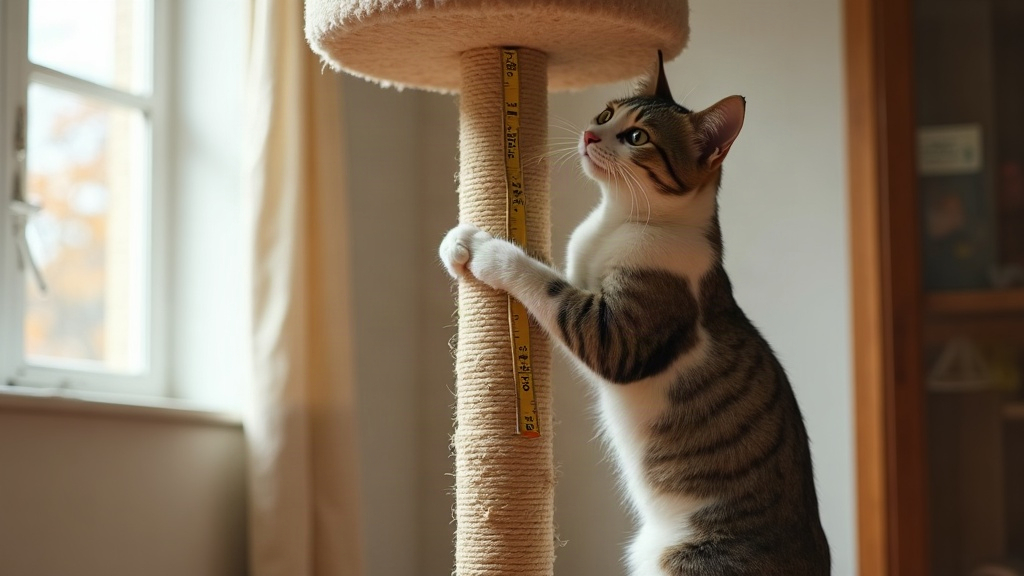
- Measure floor to ceiling in the exact spot where the tree will go — not the middle of the room.
- Check for sag or drop tiles. Older buildings settle; suspended ceilings vary. Measure in multiple spots.
- Subtract 3 inches for clearance — this is your maximum tree height.
If you’re uncertain about sizing, our cat tree sizing guide walks through matching tree dimensions to your cat’s size and your room constraints.
Quick decision tree
- Haven’t bought yet? Measure your ceiling, leave adequate clearance, buy a tree shorter than that number.
- Already have a too-tall tree? Check if a section unbolt — that’s the easiest fix.
- Very low ceiling (quite low)? Wall-mounted shelves are an excellent long-term solution.
- Want high stability? Tension-pole trees brace against the ceiling and are stable by design.
- Renting? Avoid wall shelves (drilling); look for compact freestanding trees or tension poles that don’t mark the ceiling.
What not to do
- Don’t force the tree in at an angle. A leaning cat tree is unstable and your cat won’t trust it.
- Don’t skip the wall strap on a modified tree — shortening the base without securing it increases tip-over risk.
- Don’t cut more than you need. Take small increments at a time, test fit, repeat. Cutting too much is irreversible.
Summary
Low ceilings require compromise, but not giving up on vertical cat furniture. Measure your space, do the subtraction, and pick the option that fits — whether that’s a shorter tree, wall shelves, a tension pole, or a careful modification to what you already have. Cats care about having height, not about having the tallest tree on the market.