Best Cat Tree Base Size for Large Cats (Maine Coon, Ragdoll)
As an Amazon Associate I earn from qualifying purchases. Product details may change; verify on Amazon before purchase.
🔍 How this guide was put together (Editorial Standards)
This guide compares options using published manufacturer specifications, patterns in publicly visible owner reviews, and reputable expert sources. We do not operate a physical testing lab; see our how-we-research page for details.
📑 Table of contents
- Why base size matters more for large cats
- Base size by tree height
- Base weight matters as much as footprint
- How to measure your space for a proper base
- When base size alone isn’t enough: wall strapping
- Base shapes compared
- What “heavy-duty” actually means
- Fixing an undersized base
- Frequently asked questions
The rule: Base width should be at least 50% of tree height for large cats. A 72-inch tree needs a base at least 36 × 24 inches. Most budget trees use 20 × 20 inch bases regardless of height — that’s why they wobble and tip.
Why base size matters more for large cats
Maine Coon males weigh 13–18 lb, with some exceeding 20 lb (TICA breed standard). Ragdoll males run 15–20 lb (TICA Ragdoll). When a 20-lb cat launches off the top perch, the lateral force at the base is substantial — physics doesn’t care about marketing claims.
A narrow base under a tall tree creates a high center of gravity. Add a heavy cat jumping off (not just standing), and the tree tips. This is why “tall cat trees” with small bases are the most returned cat furniture category.
Base size by tree height
| Tree height | Minimum base for 10-lb cats | Minimum base for 15-20+ lb cats |
|---|---|---|
| Under 48 in | 18 × 18 in | 22 × 22 in |
| 48–60 in | 20 × 20 in | 26 × 22 in |
| 60–72 in | 24 × 20 in | 30 × 24 in |
| 72+ in | 26 × 22 in | 36 × 24 in (or wall strap) |
These are minimums. Wider is always more stable.
Base weight matters as much as footprint
A 30 × 24 inch base made of thin particleboard still fails if it’s light. Base weight creates the low center of gravity that resists tipping.
What to look for:
- MDF or thick plywood base (heavier than particleboard)
- Base thickness 1 inch+
- Total tree weight 40+ lb for trees over 60 inches
Some manufacturers list total product weight. A 72-inch tree under 30 lb is almost certainly too light for large cats.
How to measure your space for a proper base
- Mark the footprint on your floor with tape
- Add 6 inches on each side for cat dismount clearance
- Check that no furniture blocks the “landing zone”
A 30 × 24 inch base needs roughly 42 × 36 inches of clear floor space including landing area.
When base size alone isn’t enough: wall strapping
For trees over 60 inches with Maine Coons or Ragdolls, wall strapping is mandatory regardless of base size. A wall strap removes the tipping failure mode entirely.
How to add one:
- Get a heavy-duty furniture strap (anti-tip kit)
- Loop around the top post or a cross-beam
- Anchor into a wall stud (not just drywall)
- Tension snug but not tight
See our wall anchoring guide for step-by-step instructions.
⚠️
The wobble test: Push the top perch firmly by hand. If it sways more than 2 inches, the base is too small or too light for a large cat. Wall-strap it or return it.
Base shapes compared
Square bases: Most stable in all directions; best for corner placement.
Rectangular bases: Stable along the long axis, less so along the short axis. Orient the long edge against the wall.
Circular bases: Worst stability-to-footprint ratio. Avoid for large cats.
Multi-leg bases: Some trees use 3-4 separate feet instead of a solid base. These are generally less stable than solid bases unless each leg is weighted and the span is wide.
What “heavy-duty” actually means
“Heavy-duty” in cat tree marketing usually refers to post thickness or platform size — not base size. Always check actual base dimensions in the product specs. If base dimensions aren’t listed, assume they’re too small to advertise.
See our heavy-duty cat tree guide for models with genuinely oversized bases.
Fixing an undersized base
If you already own a tree with a too-small base:
- Wall strap (first and best option)
- Add weight to the base — sandbags or a heavy board underneath
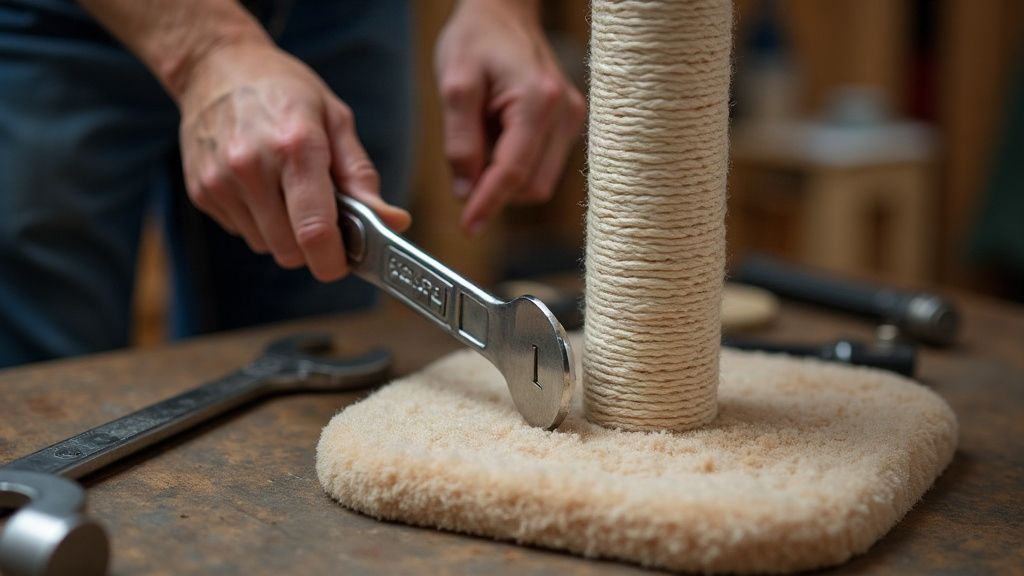
- Build a platform extension — screw a larger plywood board to the underside of the base to widen the footprint
Option 1 is the only reliable fix. Options 2-3 are workarounds.
Frequently asked questions
Can carpet help stabilize a small-base tree? Carpet actually makes it worse — the soft surface lets a rigid base rock. A solid floor or a plywood board under the base is more stable.
My cat tree says “for large cats” but the base is 20×20. Is that enough? Probably not for cats over 15 lb on trees over 60 inches. “For large cats” often means larger platforms, not larger bases.
Does multi-level design affect base requirements? Yes — a tree with perches distributed at different heights is more stable than one with all weight at the top. But a narrow base still fails if the cat launches from the highest point.
What base size for a multi-cat household? Add 4 inches to each base dimension per additional cat. Two 15-lb cats on a 72-inch tree need a base around 40 × 28 inches or a wall strap.
Related: platform perch size for large cats · sturdiest cat trees · safety checklist