Cat Trees for Multiple Cats: The Real Sizing and Territory Math
As an Amazon Associate I earn from qualifying purchases. Product details may change; verify on Amazon before purchase.
🔍 How this guide was put together (Editorial Standards)
This guide compares options using published manufacturer specifications, patterns in publicly visible owner reviews, and reputable expert sources. We do not operate a physical testing lab; see our how-we-research page for details.
📑 Table of contents
Buying one larger cat tree for multiple cats seems logical, but the actual determinant of success isn’t tree size — it’s perch count and spacing. Get this wrong and you’ll see one cat monopolize the tree while others avoid it entirely.
The perch-count rule
Minimum: one resting perch per cat, plus one extra. This mirrors standard multi-cat resource guidance for litter boxes and feeding stations — cats reduce conflict when there’s always an unclaimed option available, rather than exact 1:1 matching that creates competition at the margin.
For 2 cats: at least 3 usable perches. For 3 cats: at least 4 usable perches.
A single 3-level tree with 2 cats often works fine. The same tree with 3+ cats frequently shows one cat claiming the top spot permanently while others avoid the tree.
Why height variety matters more than total size
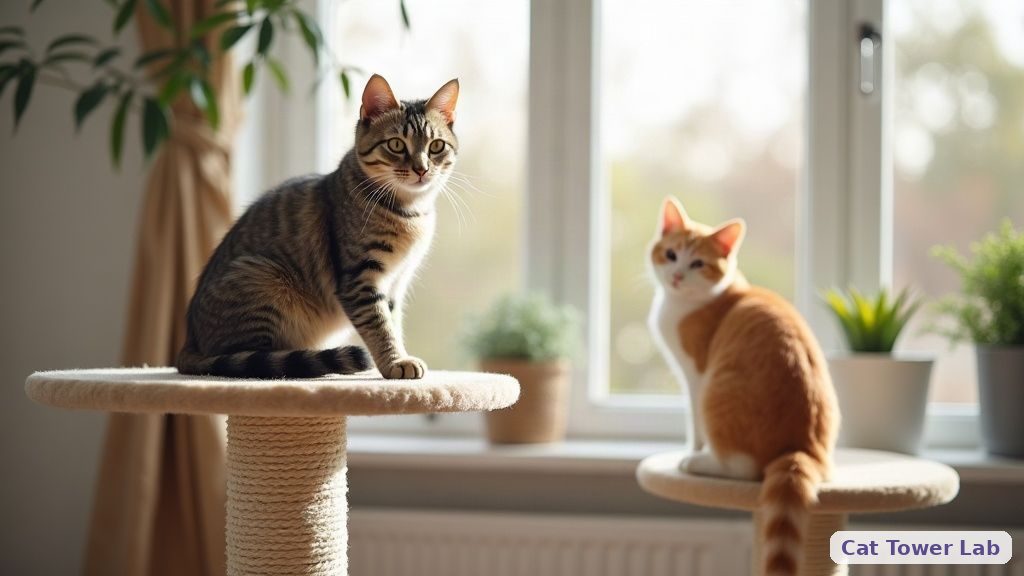
Cats establish informal hierarchy through vertical position — higher generally signals more confident/dominant in a given relationship. A tree with perches at meaningfully DIFFERENT heights (not just multiple platforms at similar levels) lets less-confident cats claim a “their” spot without directly contesting the top position.
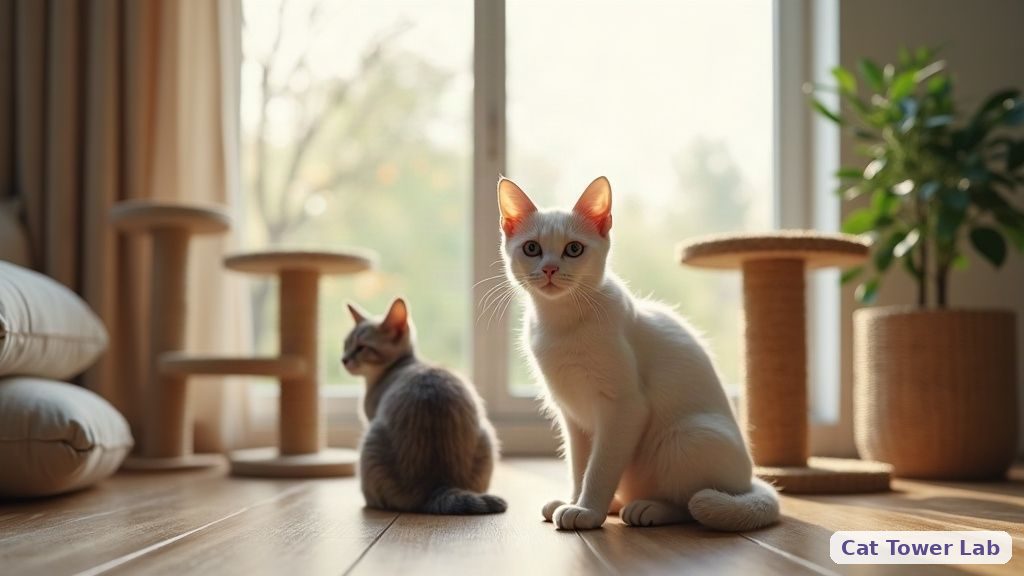
Practical setup: if budget/space allows, 2 separate trees at different locations often works better than 1 large multi-perch tree for 3+ cats — it removes the single-resource competition dynamic entirely rather than just adding more perches to the same object.
Signs the current setup isn’t working
- One cat is consistently on the tree, others are never seen using it
- Hissing or blocking behavior when a second cat approaches the tree
- Cats using furniture (bookshelves, counters) instead of the tree despite it being available
Any of these suggest insufficient perches or too little height differentiation for your specific cat group’s dynamics — not a tree quality problem.
Multi-cat + large breed combination
If your multi-cat household includes a large breed (Maine Coon, Ragdoll), stability requirements compound — see our large cat guide for the weight/base considerations, since a tree needs to handle simultaneous use by multiple cats, not just one at a time.
FAQ
How many cats can use one cat tree? Depends on perch count, not tree size alone. Use the rule of one perch per cat plus one extra — a 3-perch tree comfortably serves 2 cats but may cause competition with 3+.
Do multiple cats need separate cat trees? Not necessarily if one tree has enough perches at varied heights, but for 3+ cats, two smaller trees in different locations often reduces resource competition better than one large multi-perch tree.
Why does my cat guard the cat tree from other cats? Usually insufficient alternative perches — if there’s only one appealing spot (usually the top), cats will compete for it. Adding height-varied perches or a second tree location typically resolves this.
Should multiple cat trees be in the same room? Not required — placing trees in different rooms or areas can actually reduce competition by giving each cat their own established territory rather than shared contested space.
Can kittens and adult cats share a cat tree? Yes, if the tree has both low-accessible platforms (for kittens/seniors) and higher perches (for confident adults) — see our age-specific guide for the full breakdown.