How to Replace Sisal Rope on a Cat Tree Post
As an Amazon Associate I earn from qualifying purchases. Product details may change; verify on Amazon before purchase.
🔍 How this guide was put together (Editorial Standards)
This guide compares options using published manufacturer specifications, patterns in publicly visible owner reviews, and reputable expert sources. We do not operate a physical testing lab; see our how-we-research page for details.
📑 Table of contents
A shredded sisal post doesn’t mean you need a new cat tree. Rewrapping costs under $20 and takes about 30 minutes—less than shipping a replacement would. Here’s how to do it right.
What You’ll Need
| Material | Specification | Why It Matters |
|---|---|---|
| Sisal rope | 1/4” or 3/8” diameter, natural fiber | Cats prefer natural sisal; synthetic rope is too slick for claw grip |
| Staple gun | Heavy-duty with 5/8” staples | Holds the start/end points securely |
| Hot glue gun | Optional but helpful | Prevents unraveling during wrapping |
| Scissors/utility knife | Sharp | Clean cuts prevent fraying |
Rope length calculation: Measure the post circumference, then the height you want to wrap. Formula: (circumference ÷ rope diameter) × height = feet of rope needed. For a standard 3” diameter post that’s 24” tall with 1/4” rope: (9.4” ÷ 0.25”) × 24” = 904” = ~75 feet. Buy 20% extra for mistakes.
✅
Material quality mattersPer the ASPCA's cat enrichment guidelines, scratching is essential for cats' physical and mental health. Cheap dyed rope can fray faster and may contain dyes that aren't tested for pet safety. Look for natural, untreated sisal.
Step 1: Remove the Old Rope
- Cut through the old sisal at the top with a utility knife
- Peel it off by rotating the post—most old rope pulls off in one continuous strip
- Remove any staples left behind using pliers
- Sand any rough spots or old glue residue with 80-grit sandpaper
If the post itself is damaged (cracked wood, stripped screw holes), address that before rewrapping. See our how to fix a wobbly cat tree guide for structural repairs.
Step 2: Anchor the Rope Start
This step determines whether your wrap holds or unravels within a week.
- Position the rope end at the base of the post
- Fold over 1” of rope to double the thickness at the start point
- Drive 3 staples through this doubled section, spaced in a triangle pattern
- Add a bead of hot glue under the first wrap for extra hold
- Pull tight and begin wrapping upward
Common mistake: Single staple at the start. This fails within days of use. Always triple-staple and glue.
Step 3: Wrap Tight and Even
The technique:
- Wrap each row tight against the previous one—no gaps
- Every 6-8 wraps, push the coils down firmly to eliminate any slack
- Keep tension constant by pulling the rope at a 45° angle as you wrap
- If the post is mounted vertically, rotate the entire tree as you wrap rather than walking around it
Tension tip: The rope should feel like you’re stretching it slightly, but not deforming it. Too loose = gaps appear after first use. Too tight = rope breaks during wrapping.
Step 4: Finish the Top
- Stop wrapping when you reach the top (or the platform above)
- Cut the rope leaving 3” extra
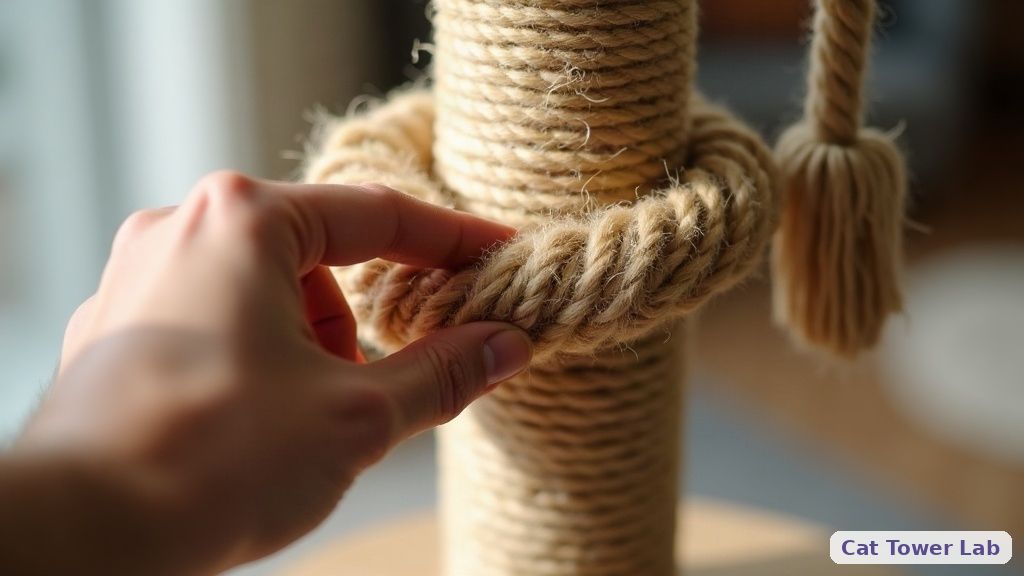
- Tuck the end under the last 2 wraps using a flat screwdriver to lift them
- Apply hot glue to secure the tucked end
- Add 2 staples through the final wraps as backup
- Trim any excess flush with scissors
Making It Last Longer
Choose the right diameter: 3/8” rope lasts longer than 1/4” because there’s more material to shred before the core is exposed. The tradeoff: it covers less height per foot of rope.
Rotate the post if possible: Some cat trees have removable posts. Rotate 90° every few months so wear distributes evenly.
Trim frayed ends: When you see whiskers of shredded fiber sticking out, trim them flush. This prevents cats from pulling entire sections loose.
According to Cornell University’s Feline Health Center, cats scratch to maintain claw health and mark territory—a well-maintained scratching surface encourages use and protects your furniture.
Sisal Rope vs. Alternatives
| Material | Durability | Cat Preference | Notes |
|---|---|---|---|
| Natural sisal | Good | High | Industry standard, rough texture cats prefer |
| Manila rope | Better | High | Slightly softer than sisal, often lasts longer |
| Jute rope | Lower | Medium | Softer, shreds faster |
| Cotton rope | Lowest | Low | Too soft for claw maintenance |
| Seagrass | Good | High | Alternative texture some cats prefer; harder to wrap |
Most cat trees ship with sisal. Manila is a worthwhile upgrade if you’re rewrapping anyway.
When Rewrapping Isn’t Worth It
Consider replacing the entire post (or tree) if:
- The wood post is cracked or splitting
- The post diameter is under 2.5” (common in budget trees; won’t hold staples well)
- You’ve rewrapped the same post multiple times already
- The platform attachments above/below the post are failing
See our cat tree materials guide for what to look for in a replacement.
FAQ
How often do I need to rewrap? Depends on usage and rope quality. With one cat using the post daily, expect 1-3 years. Multi-cat households or heavy scratchers may need rewrapping annually.
Can I wrap over the old rope? Not recommended. The old layer creates gaps, the new wrap won’t grip properly, and you double the diameter which can look odd.
My cat ignores the new rope—why? New sisal has a different smell. Rub catnip into the fresh rope or sprinkle it at the base. Most cats investigate within 24 hours.
Where do I buy sisal rope? Hardware stores (Home Depot, Lowes) carry it in the rope aisle. Amazon has bulk rolls. Verify it’s natural sisal, not synthetic “sisal-look” rope.
Related: How to Fix a Wobbly Cat Tree · Cat Tree Materials Guide