Cat Tree vs Cat Shelves: Which Takes Up Less Space? (2026)
As an Amazon Associate I earn from qualifying purchases. Product details may change; verify on Amazon before purchase.
🔍 How this guide was put together (Editorial Standards)
This guide compares options using published manufacturer specifications, patterns in publicly visible owner reviews, and reputable expert sources. We do not operate a physical testing lab; see our how-we-research page for details.
📑 Table of contents
Cat shelves take up less floor space—zero, in fact. Wall-mounted shelves occupy vertical wall area while leaving your floor completely open. Freestanding cat trees require a permanent floor footprint that ranges from roughly 1.5 to 9 square feet depending on size.
Here’s the specific space math and guidance on which option fits different living situations.
Floor footprint comparison
Wall-mounted cat shelves: 0 square feet of floor space. All structure attaches to the wall.
Freestanding cat trees by size:
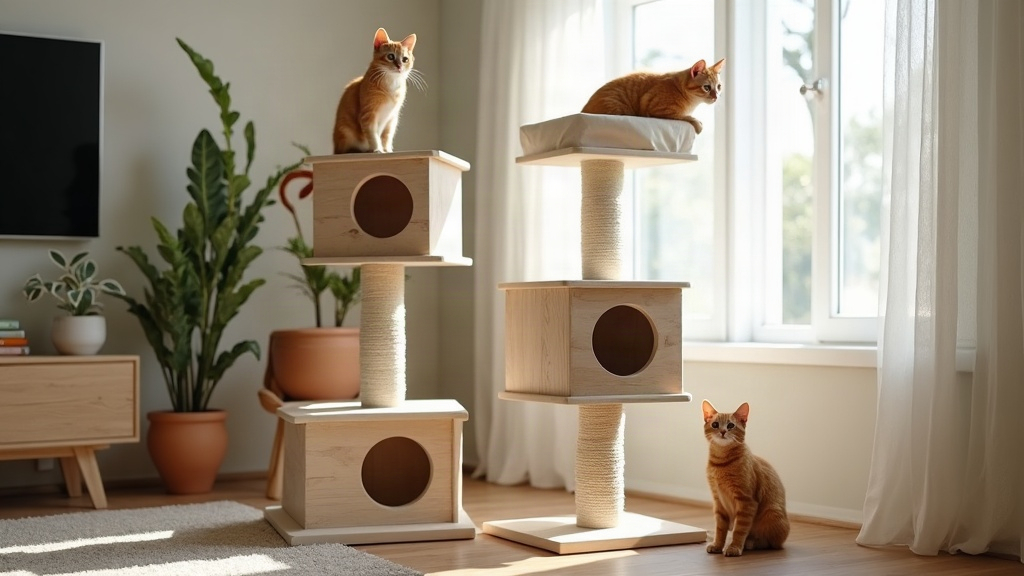
- Compact trees (under 36 inches): 15×15 to 18×18 inch base (~1.5–2.25 sq ft)
- Medium trees (36–60 inches): 18×18 to 24×24 inch base (~2.25–4 sq ft)
- Large trees (60–80 inches): 24×30 to 30×36 inch base (~5–7.5 sq ft)
- Floor-to-ceiling towers: up to 36×36 inch base (~9 sq ft)
In a 400 square foot studio apartment, a large cat tree occupies 1.5–2% of total floor area. That same space could hold a side table, floor lamp, or remain as circulation space.
Wall shelves convert dead wall space into cat territory. According to Catification by Jackson Galaxy and Kate Benjamin, vertical space above furniture, doorways, and windows is typically unused by humans but highly valued by cats.
Total space usage: shelves still win
Wall shelves project 8–12 inches from the wall (depth of the shelf). This uses airspace above furniture or in hallways, but doesn’t block floor circulation.
Cat trees project their full footprint from floor to ceiling. A 24×24 inch base means a 24×24 inch exclusion zone on your floor permanently.
For studio apartments and small one-bedrooms, wall shelves provide equivalent or greater climbing area while preserving livable floor space.
Perch area comparison
A single wall shelf typically provides 10–15 inches × 6–12 inches of perch surface (~0.4–1.25 sq ft).
A typical medium cat tree with 4 platforms might provide:
- Two small platforms: 10×10 inches each = ~1.4 sq ft
- One condo/cubby: interior ~12×12 inches = ~1 sq ft
- One top platform: 15×15 inches = ~1.5 sq ft
- Total usable perch area: ~4–5 sq ft
To match this with shelves, you’d need 4–6 individual shelves. That’s achievable on a single wall, and you’d still have zero floor space consumed.
Installation requirements
Shelves: Require wall mounting—stud finding, drilling, appropriate fasteners. Most shelves need screws into studs or heavy-duty drywall anchors. Installation takes 15–30 minutes per shelf.
According to This Old House, standard drywall anchors hold 5–10 pounds. Cat shelves need stud mounting or toggle bolts for the 20–35 pound weight ratings most require.
Trees: Zero installation. Unbox, assemble, place. Most trees assemble in 30–60 minutes with included tools.
For renters, tree setup is significantly easier—no wall holes, no repair on move-out.
Renter considerations
Most rental agreements restrict or prohibit wall modifications. Installing 6 shelves leaves 24+ screw holes. Even with repair, landlords may object to modification.
Freestanding trees require no landlord approval. They’re furniture, not structural modification.
If you rent, a tree is probably your only option unless you have explicit permission or a very permissive lease. Our cat towers for small apartments guide covers compact freestanding options.
Combination approach
You don’t have to choose exclusively. Many cat owners use:
- A compact tree (2×2 ft footprint) as “base camp” with scratching posts and a condo
- Wall shelves for extended vertical range and climbing routes
This provides scratching surfaces, hiding spots, and floor-to-ceiling climbing without a massive tree footprint.
Feature comparison
| Feature | Cat Tree | Wall Shelves |
|---|---|---|
| Floor space used | 1.5–9 sq ft | 0 |
| Installation | None (assemble only) | Drilling required |
| Renter-friendly | Yes | Usually no |
| Scratching surface | Typically included | Rarely included (add separately) |
| Hiding spots | Often included (condos) | Rarely included |
| Expandable | Replace entirely to expand | Add shelves incrementally |
| Moveable | Yes | No (fixed to wall) |
When to choose shelves
- You own your home or have landlord permission
- Floor space is at a premium
- You have a climber cat who values height over hiding
- You want an expandable system you can grow over time
- Aesthetics matter—shelves can look like intentional design, not cat furniture
When to choose a tree
- You rent and can’t modify walls
- You need scratching surfaces included
- Your cat prefers hiding spots (condos, cubbies)
- You want a single purchase that provides complete cat furniture
- Easy relocation matters (moving, room rearrangement)
Our recommendation by apartment size
| Space | Recommendation |
|---|---|
| Studio/micro apartment (<400 sq ft) | Wall shelves if allowed; ultra-compact tree if not |
| Small 1-bedroom (400–600 sq ft) | Compact tree + 2–3 shelves if allowed |
| Standard 1-bedroom+ | Medium tree is fine; shelves optional |
| Renter, any size | Tree only (no wall modification) |
For detailed shelf installation guidance, see our wall-mounted cat shelves guide.
Bottom line
Wall-mounted cat shelves objectively take up less space—zero floor space versus 1.5–9 square feet for a tree. But shelves require installation and usually aren’t renter-friendly. If you can install shelves, they’re the space-efficient choice. If you can’t, a compact freestanding tree is the practical solution.
Sources
- Jackson Galaxy & Kate Benjamin: Catification — Vertical space utilization for cats
- This Old House: Wall Anchors Guide — Fastener weight limits for wall mounting