Is a Wall-Mounted Cat Shelf Better Than a Freestanding Tree? (2026)
As an Amazon Associate I earn from qualifying purchases. Product details may change; verify on Amazon before purchase.
🔍 How this guide was put together (Editorial Standards)
This guide compares options using published manufacturer specifications, patterns in publicly visible owner reviews, and reputable expert sources. We do not operate a physical testing lab; see our how-we-research page for details.
📑 Table of contents
Wall-mounted shelves win for floor space; freestanding trees win for flexibility and cat confidence. The right choice depends on your living situation, wall construction, and whether your cat is a climber or a lounger.
Here’s how each option performs across the factors that actually matter—and a clear recommendation for different living situations.
Space comparison: wall-mounted saves floor area
Wall-mounted shelves occupy zero floor space. A vertical climbing wall using four to six shelves can provide the same usable perch area as a 72-inch freestanding tree while leaving your floor completely open.
According to Catification authors Jackson Galaxy and Kate Benjamin, wall-mounted setups are ideal for small apartments because they utilize vertical space that would otherwise go unused. A typical studio apartment gains significant functional space when cat furniture moves to the wall.
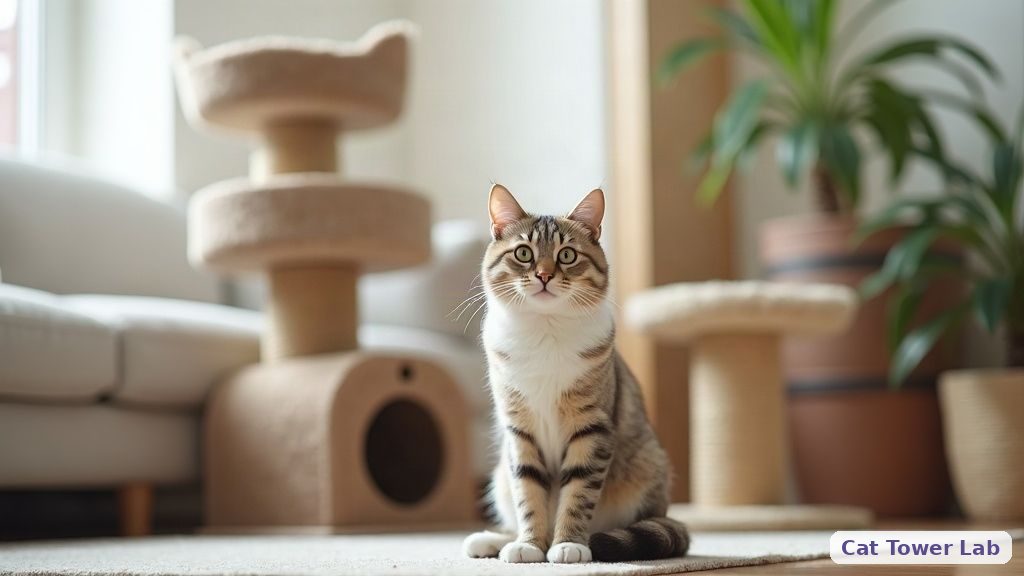
Freestanding trees require a footprint of at least 18×18 inches for a small unit, and 24×36 inches or more for multi-cat towers. In a 400-square-foot apartment, that footprint represents meaningful floor loss.
Winner: Wall-mounted for small spaces and minimalist setups.
Stability comparison: freestanding trees are inherently stable
A quality freestanding cat tree sits on a weighted base and supports itself. No wall attachment means no concerns about stud placement, drywall anchors, or weight limits.
Wall-mounted shelves must be installed correctly or they fail catastrophically. According to This Old House, drywall alone can hold about 5–10 pounds per anchor without a stud. A 15-pound cat jumping onto a poorly anchored shelf can rip the bracket out of the wall.
Proper wall-shelf installation requires:
- Locating studs (a stud finder is essential)
- Using appropriate fasteners: lag screws for studs, toggle bolts for hollow walls
- Weight rating verification: most commercial cat shelves specify 20–35 pound limits
If you rent and cannot modify walls, or if your walls are plaster, concrete, or another challenging material, freestanding remains the safer choice.
Winner: Freestanding for ease and universal applicability.
Cat preference: varies by individual
Some cats are natural climbers who prefer high, narrow perches—these cats thrive on wall systems. Others are “bush dwellers” (Jackson Galaxy’s term from Total Cat Mojo) who prefer enclosed spaces at ground or mid-level—these cats may ignore wall shelves entirely.
Watch where your cat currently spends time. If they’re on top of bookcases and refrigerators, wall shelves will appeal to them. If they’re under beds and in closets, a freestanding tree with enclosed condos is a better match.
Freestanding trees typically offer more variety in a single unit: scratching posts, condos, hammocks, and multiple platform levels. Wall shelves excel at pure vertical climbing but often lack scratching and hiding options unless you add separate components.
Winner: Tie—depends on individual cat behavior.
Installation effort
Freestanding trees require zero tools. Unbox, assemble (usually 30–60 minutes with an Allen wrench), place, done.
Wall-mounted shelves require:
- Stud finder
- Level
- Drill with appropriate bits
- Correct fasteners for your wall type
- Time: 15–30 minutes per shelf
If you install 6 shelves to create a climbing wall, that’s 2+ hours of installation versus 45 minutes for a comparable freestanding tree.
Winner: Freestanding for convenience.
Cost comparison
Entry-level freestanding trees start around $50–80. Premium floor-to-ceiling models run $200–400.
Wall shelf systems vary widely:
- Single floating perch: $25–50
- A complete 6-piece climbing wall system: $150–300
- Custom designer systems (Catification-style): $400+
Dollar-for-dollar, freestanding trees provide more usable surface area. However, wall systems can be expanded incrementally—you can start with two shelves and add more as budget allows.
Winner: Freestanding for value; wall-mounted for incremental investment.
Renter considerations
Most landlords prohibit wall modifications or require repair upon move-out. A wall-mounted cat shelf setup leaves 8–24 holes per shelf (depending on bracket design).
If you rent, freestanding is the path of least resistance. If you own or have a cat-friendly landlord, wall-mounted becomes viable.
For space-constrained renters, our cat towers for small apartments guide covers freestanding options with minimal footprints.
Our recommendation by situation
| Situation | Recommendation |
|---|---|
| Small apartment, homeowner | Wall-mounted—maximize floor space |
| Small apartment, renter | Freestanding with compact footprint |
| Large home, any ownership | Freestanding—simplicity wins when space isn’t scarce |
| Multiple cats | Freestanding multi-level tree—more perches, more hiding spots |
| Senior or arthritic cat | Freestanding with ramps—wall shelves often require jumping between levels |
| Climber cat (always on high surfaces) | Wall-mounted—these cats will use every inch |
| Bush-dweller cat (prefers hiding) | Freestanding with condos |
Hybrid approach
You don’t have to choose exclusively. A freestanding tree provides base-camp territory, scratching, and enclosed spaces. A few wall shelves extend your cat’s vertical range without replacing the tree.
For guidance on maximizing vertical space, see our wall-mounted cat shelves guide.
Bottom line
Wall-mounted shelves solve the floor-space problem elegantly but require proper installation and aren’t renter-friendly. Freestanding trees are plug-and-play, universally stable, and offer more features per dollar. Choose wall-mounted if you own your home and have a climbing cat in a small space. Choose freestanding for everything else.
Sources
- Jackson Galaxy & Kate Benjamin: Catification — Wall-mounted design principles for small spaces
- This Old House: Wall Anchors Guide — Drywall weight limits and fastener types
- Jackson Galaxy: Total Cat Mojo — Bush-dweller vs tree-dweller behavior