Tall vs Short Cat Tree: Which Works for Apartments, Low Ceilings, Senior Cats?
As an Amazon Associate I earn from qualifying purchases. Product details may change; verify on Amazon before purchase.
🔍 How this guide was put together (Editorial Standards)
This guide compares options using published manufacturer specifications, patterns in publicly visible owner reviews, and reputable expert sources. We do not operate a physical testing lab; see our how-we-research page for details.
📑 Table of contents
Short answer: Most adult cats prefer tall trees (60”+) because they want to survey from above. But short trees (under 48”) are better for senior cats with arthritis, kittens under 4 months, and spaces with low ceilings. Here’s the detailed breakdown.
Height Categories
| Category | Height Range | Best For |
|---|---|---|
| Short | Under 48” | Seniors, kittens, low ceilings |
| Medium | 48-60” | Standard apartments, most cats |
| Tall | 60-72” | Active adults, multi-cat homes |
| Floor-to-ceiling | 72-100”+ | Bengals, climbers, high ceilings |
Why Cats Prefer Height
According to Jackson Galaxy, cat behaviorist and host of My Cat From Hell, vertical territory serves three functions:
- Security: Height = safety. Cats feel invulnerable when they can see threats coming.
- Confidence: The cat at the highest point is the “top cat” in multi-cat homes.
- Enrichment: Climbing burns energy and satisfies the prey-stalk-climb instinct.
This is why a cat will often ignore a short cat tree but climb your bookshelf—they want the highest available spot.
Tall Cat Trees (60”+)
Pros
- Satisfies the height instinct—cat will actually use it
- Better for multi-cat homes (vertical pecking order)
- Usually includes more features (scratching posts, condos, perches)
- Replaces bookshelf/counter climbing for most cats
Cons
- Requires wall anchoring for safety (any tree over 60” should be strapped)
- Takes up visual space; can feel dominating in small rooms
- Harder to assemble solo (see our single-person assembly guide)
- Not suitable for low ceilings (under 8’)
Who Should Buy Tall
- Adult cats under 10 years old
- Active breeds (Bengals, Abyssinians, Siamese)
- Multi-cat households (need vertical separation)
- Cats that currently climb furniture
✅
Ceiling clearance ruleCat tree height should be ceiling height minus 12-18 inches. This lets your cat sit on top without crouching. An 8' ceiling (96") can handle up to 78-84" trees.
Short Cat Trees (Under 48”)
Pros
- Safer for seniors and kittens (lower fall risk)
- No wall anchoring needed in most cases
- Fits under windows, in corners, small spaces
- Easy to move and clean
- Lower price point typically
Cons
- Many adult cats ignore them (not high enough)
- Limited vertical territory in multi-cat homes
- Fewer features typically (less climbing value)
Who Should Buy Short
- Senior cats (10+ years) with mobility issues
- Kittens under 4 months (until coordination develops)
- Cats with arthritis or joint problems
- Spaces with ceilings under 7.5’
- Second tree in a multi-tree setup
Scenario-Based Recommendations
Small Apartment (Under 600 sq ft)
Problem: Limited floor space, but cat still needs height.
Solution: Medium-tall tree (54-66”) with a small footprint base. Look for vertical designs with platforms stacked directly above each other rather than sprawling outward. Or: wall-mounted shelves instead of a floor tree.
See our cat trees for small apartments guide for space-efficient picks.
Low Ceilings (7-7.5’)
Problem: Standard 60”+ trees leave no head room.
Solution: Trees under 54”. Calculate: ceiling height (in inches) minus 18” = max tree height. A 7’ ceiling (84”) limits you to ~66” trees maximum, but 54” is more comfortable.
Senior Cat with Arthritis
Problem: Can’t jump high, but still needs vertical territory.
Solution: Short tree (36-48”) with gentle ramp access. The Cornell Feline Health Center notes that arthritis affects an estimated 90% of cats over 12 years. Prioritize:
- Wide, stable platforms (easy to land on)
- Ramps or closely-spaced steps
- Low entry point (first perch under 15” high)
See our cat trees for senior cats guide for specific picks.
Kitten (Under 6 Months)
Problem: Kittens climb recklessly and fall.
Solution: Short-to-medium tree (under 48”) until coordination develops around 4-6 months. After that, they can handle any height. Kittens under 3 months should start with platforms under 24” high.
Multi-Cat Household
Problem: Cats need vertical separation; one tree isn’t enough space.
Solution: One tall tree (60”+) in the main living area, plus additional vertical territory elsewhere. Options:
- Second medium tree in another room
- Wall-mounted cat shelves
- Cat-safe access to a bookshelf top
Height pecking order prevents conflict. If you only have one short tree, cats will fight for the single top spot.
Floor-to-Ceiling Trees: Special Considerations
Tension-mounted (floor-to-ceiling) trees maximize vertical space but require:
- Solid ceiling: Some drop ceilings and older plaster can’t take the pressure
- Regular re-tensioning: Check tension monthly; loosening = wobble
- Not for heavy cats: Most tension poles are rated for 15 lbs max
- Professional installation advised for ceilings over 9’
These are best for Bengals, Abyssinians, and other climbers who will use the full height.
Making a Short Tree Work
If you’re stuck with a short tree (rental restrictions, low ceiling, senior cat), maximize its value:
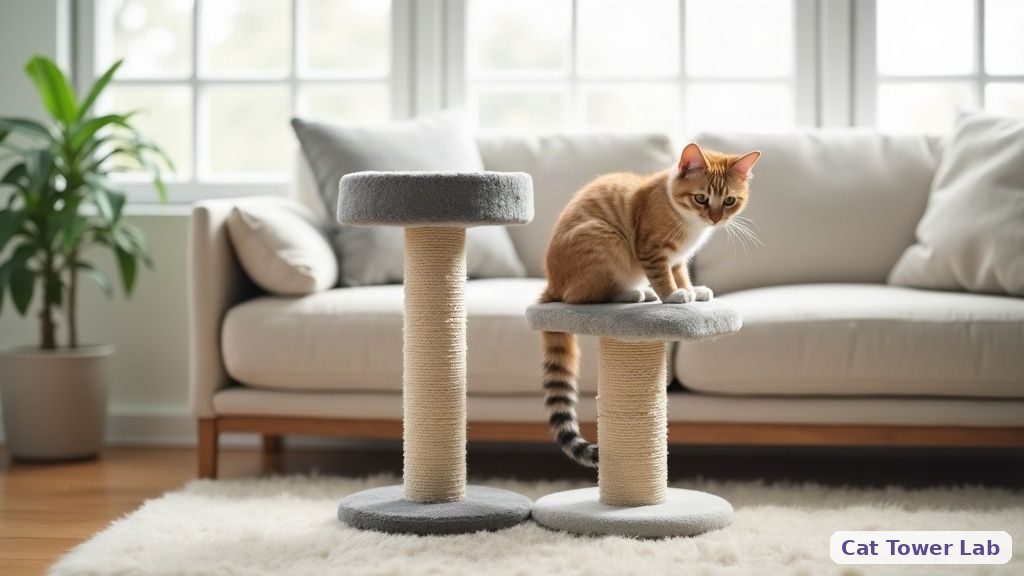
- Place on furniture: Put the tree on a sturdy table to add height
- Combine with shelves: Wall shelves above the tree extend climbing options
- Window placement: A short tree in front of a window is more valuable than a tall tree in a dark corner
- Multiple short trees: Two 36” trees in different rooms beats one 60” tree
FAQ
My cat ignores the tall tree but sits on my refrigerator—why? Refrigerators are often the highest spot with the best view. Your tree may be in a corner with poor sightlines. Move it to a location with a wide view of the room.
Can a senior cat use a tall tree? Yes, if it has low first platform (under 18”) and platforms close enough to step between (12-15” gaps). They can climb; they just can’t leap.
Is there a minimum height? For adult cats to use consistently, at least 36”. Below that, it’s really just a scratcher with a platform, not vertical territory.
Kitten is already climbing the 72” tree—should I stop her? After 4 months, kittens can handle height. Before that, watch for clumsy falls. You can block upper levels temporarily by removing top platforms or placing the tree in a corner with limited launch angles.
Related: Cat Trees for Senior Cats · Cat Trees for Small Apartments