How to Disinfect a Used Cat Tree Before Bringing Home
As an Amazon Associate I earn from qualifying purchases. Product details may change; verify on Amazon before purchase.
🔍 How this guide was put together (Editorial Standards)
This guide compares options using published manufacturer specifications, patterns in publicly visible owner reviews, and reputable expert sources. We do not operate a physical testing lab; see our how-we-research page for details.
| Rank | Product | Name | Why we picked it | Buy |
|---|---|---|---|---|
| Top pick | Rocco & Roxie Supply Co. Professional Enzymatic Cleaner Spray | Check price |
📑 Table of contents
- Step 1: Outdoor Quarantine and Initial Assessment
- Step 2: Complete De-Furring and Particulate Removal
- Step 3: Enzymatic Pre-Treatment for Organic Contamination
- Step 4: Antifungal Disinfection for Ringworm Elimination
- Step 5: Parasite and Flea Egg Destruction
- Step 6: Final Structural Tightening and Odor Verification
- Frequently Asked Questions
- Sources
Editorial Note: Curated by the Cat Tower Lab Research Team, referencing veterinary infectious disease protocols from Cornell University College of Veterinary Medicine, the ASPCA Animal Poison Control Center, and the Companion Animal Parasite Council (CAPC).
A used cat tree can harbor invisible pathogens from the previous household that pose serious health risks to your cat. Ringworm (Microsporum canis) fungal spores survive on environmental surfaces for 18 months or longer according to Cornell University College of Veterinary Medicine dermatology research. Flea eggs remain dormant in carpet fibers until body heat triggers hatching. Feline parvovirus persists on contaminated surfaces for up to one year.
Before placing any secondhand cat tree in your home, complete this full-spectrum disinfection protocol to eliminate biological hazards your cat cannot see but will certainly inhale, groom, and absorb.
Step 1: Outdoor Quarantine and Initial Assessment
Never bring a used cat tree directly into your living space.
- Outdoor Staging: Transport the used tree to a garage, covered patio, or backyard. Keep it isolated from your cat until disinfection is complete.
- Visual Inspection: Examine all fabric surfaces under direct sunlight for circular bald patches (ringworm indicator), black specks (flea dirt/dried blood), and crusty residue (dried urine or vomit).
- Structural Assessment: Check for mold growth inside enclosed condos and underneath platform bases. Mold indicates moisture damage and likely bacterial colonization—consider discarding the unit.
Step 2: Complete De-Furring and Particulate Removal
Pathogen spores embed themselves in fur and dander layers. Mechanical removal must precede chemical treatment.
- Rubber Rake Extraction: Drag a rubber pet hair remover or squeegee across all carpeted surfaces. This pulls embedded fur into collectible clumps that contain concentrated pathogen loads.
- High-Suction Vacuuming: Use a vacuum with a HEPA filter to capture microscopic fungal spores and parasite eggs. Empty the canister or dispose of the bag immediately in a sealed outdoor trash container.
- Sisal Brushing: Scrub sisal posts with a stiff bristle brush to dislodge trapped claw sheaths and debris. Work outdoors to prevent indoor spore dispersal.
Step 3: Enzymatic Pre-Treatment for Organic Contamination
Cat urine, vomit, and fecal matter contain proteins that standard disinfectants cannot fully break down. Enzymatic cleaners use biological catalysts to consume these organic compounds at the molecular level.
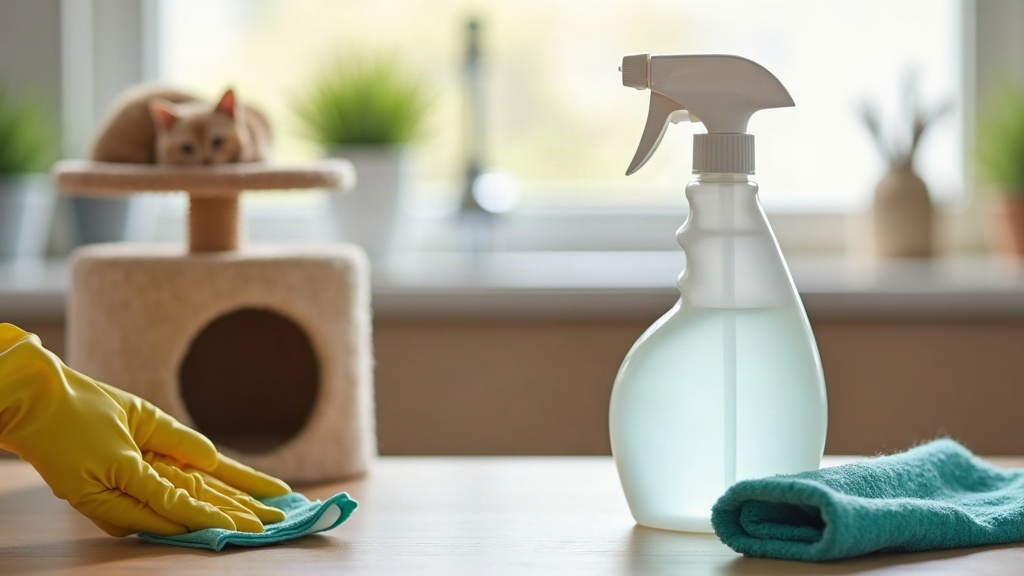
- Saturation Application: Spray enzymatic cleaner liberally over all carpeted and fabric surfaces. The formula must remain wet for 10-15 minutes to activate biological breakdown.
- Condo Interior Focus: Remove any detachable platforms and treat interior condo walls where hidden urine marking is common.
- Dwell and Blot: After enzyme activation, blot excess moisture with clean microfiber cloths. Do not rinse—residual enzymes continue working as they dry.
Step 4: Antifungal Disinfection for Ringworm Elimination
According to the ASPCA and veterinary dermatology literature, ringworm spores require specific antifungal treatment—standard household cleaners are ineffective.
- Dilute Bleach Solution (Removable Parts Only): Mix 1:10 household bleach to water. Submerge removable plastic platforms and washable fabric components for 10 minutes. Rinse thoroughly and sun-dry completely. Do not apply bleach to carpeted surfaces or sisal—it degrades fibers and remains toxic.
- Accelerated Hydrogen Peroxide Wipe: For non-submersible carpeted platforms, use veterinary-grade accelerated hydrogen peroxide wipes (sold as “AHP disinfectant”). These are effective against dermatophyte spores without bleach toxicity.
- 48-Hour Sunlight Exposure: UV radiation kills fungal spores. Position the entire structure in direct sunlight for two consecutive days, rotating every 12 hours to expose all surfaces.
Step 5: Parasite and Flea Egg Destruction
The Companion Animal Parasite Council (CAPC) notes that flea eggs and larvae survive in carpet fibers for weeks, hatching when stimulated by vibration and warmth.
- Steam Treatment (Preferred): If available, apply a handheld garment steamer to all fabric surfaces. Temperatures above 140°F (60°C) kill flea eggs, larvae, and adult parasites instantly.
- Diatomaceous Earth Application: Sprinkle food-grade diatomaceous earth across carpeted platforms. Leave for 24 hours, then vacuum. The silica particles physically damage insect exoskeletons.
- Permethrin Warning: Never apply permethrin-based flea sprays to cat furniture. According to ASPCA Animal Poison Control, permethrin is highly toxic to cats and causes seizures, tremors, and death even from residual contact.
Step 6: Final Structural Tightening and Odor Verification
- Hardware Torque: Lift carpet flaps and tighten all internal bolts with an Allen key. Used trees often arrive with loosened connections from transport.
- Sniff Test: After 48-72 hours of drying, perform a close-range smell test. Persistent ammonia odor indicates incomplete enzymatic treatment—repeat Step 3.
- Quarantine Period: Keep the disinfected tree in a separate room for 7 days before allowing your cat full access. Monitor for any delayed mold growth or odor return.
📚 Related Guides
- For routine maintenance after disinfection, follow our How to Clean a Cat Tree: Urine, Vomit, Embedded Fur & Deep Maintenance protocol.
- If the used tree fails inspection, consult our Best Cat Trees for Large Cats buying guide for safe replacement options.
🔧 Interactive Planning Tool
Evaluating structural integrity? Use our Cat Tree Stability & Structural Sizing Engine to verify whether the used tree can safely support your cat weight.
Frequently Asked Questions
How long do ringworm spores survive on cat tree surfaces?
According to Cornell University College of Veterinary Medicine, Microsporum canis (the primary ringworm species affecting cats) produces spores that remain viable on environmental surfaces for 18 months or longer. This is why thorough antifungal treatment is non-negotiable for any used cat furniture.
Can I use Lysol or household disinfectant spray on a used cat tree?
Standard household disinfectants like Lysol contain phenolic compounds that are toxic to cats. They also leave residue that cats ingest during grooming. Use only recommended enzymatic cleaners or diluted bleach on removable non-fabric components (with thorough rinsing).
Is it safe to buy a used cat tree if the previous cat had no known health issues?
Cats shed ringworm spores asymptomatically—a healthy-looking cat can be a carrier without visible symptoms. Flea eggs also remain dormant long after an infestation appears resolved. Always complete the full disinfection protocol regardless of the seller verbal assurances.
When should I discard a used cat tree instead of disinfecting it?
Discard the tree if you observe: visible mold inside enclosed condos, severe structural wobble that cannot be corrected by tightening bolts, saturated urine odor that persists after two enzymatic treatments, or particleboard swelling from moisture damage. Pathogens embedded in deteriorated materials cannot be fully eliminated.